Thanks @mcleod for the motivation this morning. Great idea. I hope all pick up on this.
When it comes to education, we have to stop pretending…
Covering content is the same as creating content.
Talking about critical thinking instead of doing critical thinking.
Sitting in rows, having students grouped by age is the best way to learn.
Learning is best done when broken up into subjects and units.
Textbooks are the best material to drive our lessons.
What are yours?
Please join us. When it comes to education, what are 5 things that we have to stop pretending? Post on your blog, tag 5 others, and share using the #makeschooldifferent hashtag. Please visit +Scott McLeod blog, http://dangerouslyirrelevant.org/2015/04/we-have-to-stop-pretending.html to see his original post.
Write it in a blog, post 5 tweets. Tag 5 other people. Use the #makeschooldifferent tag.
I tagged, @tina_zita @pmillerscdsb @Gregbagby @jameseliasnunes @plugusin @leslie_edu
I have been thinking about this post for awhile and my motivator today comes from spending a day with my son and then reading a post by @gcouros entitled, 5 Ideas for Conversations on Change.
If we lead with what is best for kids, good things will always happen.
We should always do what is best for our students. From my days developing DI portfolios for grade 10 History, to hand coding webpages so that my class and their parents could have access to materials, to embedding a critical thinking methodology into department courses, they were always done because I believed it to be best for kids. It was this conviction that built support for these ideas from department members and other staff. While I may have had the initial nugget of an idea it was only ever with the help, support and the willingness to innovate from my colleagues that allowed these ideas to come to fruition. Great things can happen when you start working from what is best for students.
Help teachers know where they are and where they need to go.
No teacher wakes up and says, "today I choose to do exactly what I have done before even if it isn't good for kids." Most teachers and administrators, do what they believe to be best for kids. Even when they can't do what was best for kids, it isn't because of a lack of want. It is usually because they can't get from their start line to the finish, or they do not even know where the finish is - or if the finish even exists (in education there really is no finish). No teacher ever wants to be left behind. It is our job to listen to their concerns and wisdom from years of teaching and seek common ground. If a teacher isn't doing what's best for kids in our eyes, they are not certainly doing what's worst for kids in their eyes. We need to see things from their perspective; find common ground and start building our common ground to start working towards what is best for kids. It is better to support teachers than pull them along.
How many times have you seen in movies where someone falls of a cliff, building, airplane, etc. and someone else catches them? How often is that really successful? Would you rather just save someone or develop someone? Supporting our teachers through change will have a far greater impact than just pulling them begrudgingly along. This will be a long journey and cannot be done over night. Break this journey up, provide markers for success and check ins for help. Supporting people is the key to doing what is best for kids. We need to let teachers know it is safe to step outside of their comfort zone and try something new. When teachers do this they are putting themselves out there and they need to know we support them. When this starts to happen, good things will come about.
Listen, model, learn together - My day cross country skiing.
As an example, yesterday my family and I went cross-country skiing, at first it was a challenge for my son. He was doing something he never had done before. He was uncomfortable and embarrassed as he kept falling going up hills. I could have lead him, gone in front and pulled him up the hill. It would have been quicker, it would have been easier, but what would have been learned? Instead I stayed behind, offering suggestions and support, occasionally coming up beside him to listen to him and try and figure out what he was attempting to do. I then attempted to model technique (with all my none cross country experience) and eventually it clicked for him and we were off on our journey, together!
There are times on Twitter where I have come across a really great idea and I get motivated to take that idea and pair it with a great visual to share with others. I thought I would use this post to share the collection of my favourites. Besides being on Twitter, I have these on my wall in my office, the LFD tvs at the school and up on old school bulletin boards.
I made these images with @canva. A great tech tool canva.com.
You can find these images on twitter, @vptechnodork. Share away.
Be Great because...You are Great. My great tweep @gregbagby as this as part of his Twitter profile.
My kids inspired this, when things weren't going so well for me one day they said this line.
Yeah we all get the Sunday night nerves. Admitting it is half the battle. Are students get these nerves as well. Just a reminder that the WE can handle it. Bring the AWESOME!
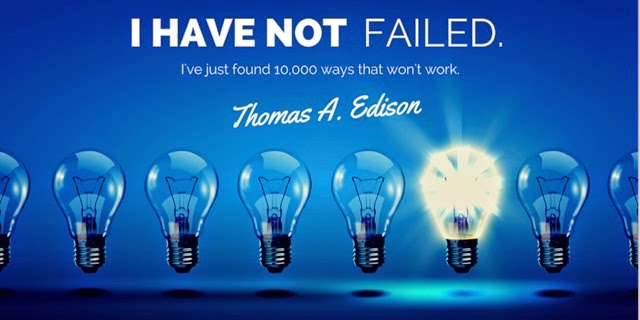
We are developing staff and student understanding of Growth Mindset. I read an article about Canada's World Junior loss last year and the goalie had this great line about dealing with failure. Even funnier, my son's own hockey team is not doing so hot this year. My son read this and said, "wow dad, my team has learned a lot this year!"
This was simply my one word for this year. Resilience. Our students and staff need more of this.
When are students want to pack it in when the learning pushes them past their comfort zone.
Just developing our understanding for the benefits of failure.
#edtech is not the solution to improving education. Yeah I said it.
The benefits of Twitter. U can also check out the evolution of this image from a storify I put together. Value of Twitter on Storify
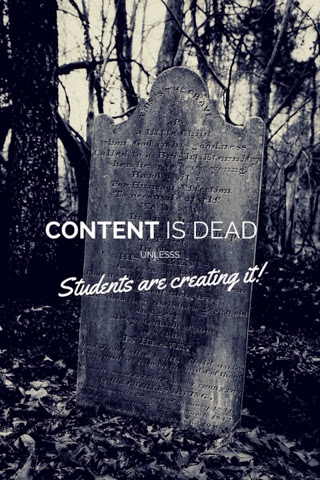
My message on creation vs content.
From @rmbyrne keynote at #BIT2014
My perspective on having students look up content.
My view on social media.
How I work, how I lead.
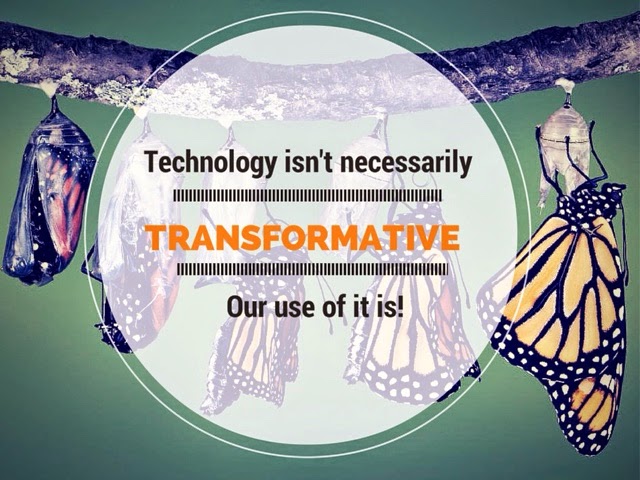
Technology is only powerful if we use it with a purpose.
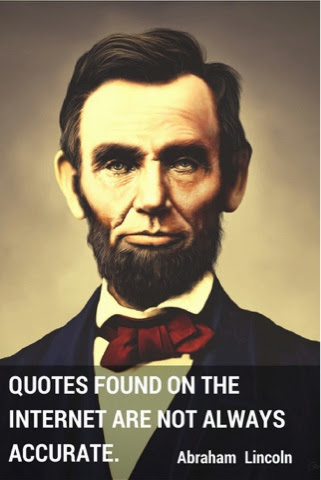
Reliability of information. Expression found on a t-shirt.
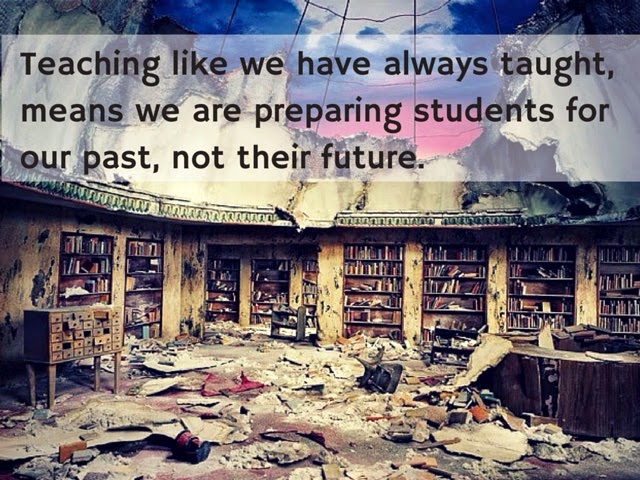
We need to change teaching.
That's it, that's all for now. Find me @vptechnodork and full sized images are there. Share away.
This post was inspired by 8amber8 and her blog http://technicallyteamann.com. Amber posted about what her big three are when it comes to admin. I thought I would come up with something new, something brilliant. Then I realized I am me and that's simply not possible.
I then returned to the tag line of my blog, these are and will be my big three:
Instruction leads the learning for staff and students in a school. Learning is the cornerstone, the foundation for everything we do. If we are not all learning effectively, what is the point? We need to ensure that we keep this focus when the maelstrom of issues get thrown at us, if we do this we will always have a focus and clarity to see us through to our goal.
The connections we make, the relationships we development with students and staff are the next most important thing we can do. It is the WHO we are, not the what we do that will bring our reluctant learners (students and staff) into our building, into our learning. These connections, both virtual and realtime, are truly what will help us maintain focus and direction in times of crisis or disruption. When we are able to show students and staff the relationships/connections between ideas and knowledge real learning happens. Relationships/connections matter.
Once we have our learning, our instruction, our relationships and connections created we can truly empower learning for all. This empowerment can come from our use of technology as we give everyone in our school a voice. A voice they might not have had if it were not for our instruction, or relationships and if we did not empower them through the use of technology. Student voice will come from their ability to create tremendous products of their learning.
While I have a continuum for my big three, could I put them in a hierarchy? Let me know what you think.
Over the last several years, I have engaged in some professional dialogue and at times heated conversations regarding what education should look like. More often than not I have pointed to the remarkable amount of change our world and society has seen over the last 200 years, yet how little the education system has changed. As I enjoy this installment of the #peel21st blog hop, I am looking forward to seeing what learning should look like today. Please don't forget to check out the other blog posts found at the bottom of this post.
________________________________
Education needs to be about students and teachers being:
Content maker, creator, knowledge inventor, skill development driven.
Together:
Through a co-learning approach where we synthesize and evaluate ideas in order to create new information and new ideas.
We become change makers as we discover connections between ideas, available content and people. We are living the words of Alvin Toffler - we learn, unlearn and relearn.
We need to make:
A shift to real world experiences, where we engage in project based learning in both face-to-face and virtual environments to make connections between new ideas and connections with each other. Through this interaction, we will find relations between things we have tried too long to keep apart. These projects, connections and relations need to be grounded in a framework of critical thought that allows us to synthesize and evaluate the new information before us. That's it, that's all...I wrote this whole post without saying 21st Century or technology! Oh darn I just did! Other blogs involved in this blog hop:
How do you ensure the excitement of learning from a conference, staff meeting, guest speaker or keynote moves beyond the event and gets embedded in your school? How do you ensure deep impact?
Our school team just returned from BIT14. What a great conference with loads of exposure to new ideas of how to effectively integrate technology into the classroom. Our staff was pumped and their excitement only continued to grow as the the conference continued. Staff came back talking about what they learned, were tweeting out about their learning and even after the conference emailed and called me with their plans for implementation once we got back to our school.
As I sat at home on Friday evening, I started to reflect on our plan to stretch this excitement out to ensure that the knowledge gained at the BIT14 conference has a meaningfully impact at our school.
Too often staff excitement that builds while they are immersed in professional learning at a conference gets quickly eroded away as they return to school and the demands of our job (report cards, lesson plans, student issues, etc) way heavy on our time and we forget about what we have learned. I get it, I was there. So how do we get this learning and excitement to be more than a flash in the pan?
As we were at the conference, we would sit and debrief our learning over breakfast, at lunch and during dinner. I started the conversation early over how do we bring this back to school, how to ensure our participation at the conference, our excitement and our new leanings has a long-lasting and meaningful impact on our school. I brought up the idea of 'first-followers" with our staff. We discussed their role to bring the other teachers along at our school. I talked about Derek Shivers' video, Leadership Dancing Guy, as a good example:
While our first followers are the ones that are already won over, it is the 2nd, 3rd and fourth followers who are even more important. How do we get these staff involved? For me this question and the answer, is important in stopping the flash in a pan syndrome. This is our task, myself being the leadership dancing guy and those staff who attended, BIT14, the first followers need to accomplish.
Our Ideas (they are not in any order of significance):
Admin Support
Heck our principal approved staff attendance at the conference and is always willing to find creative ways to support staff in their learning. Our admin team has a highly consultative process and reach out to staff in order to determine their professional learning needs. Our Principal even wants to try an edcamp style staff meeting. The support is there, the modelling is there, the direction is there.
Professional learning opportunities for all staff
We are hosting a series of connected lunch and learns using Microsoft Lync 2013. This provides teachers access from their classroom, during their preparation periods or after school. We took staff input on what they wanted to learn and will provide a series of workshops that are leveled (from noob to expert) in order to meet staff where they are. We are creating a great collaborative culture where staff can learn from each other. We have created groups of staff who are exploring Learning Management Systems to ensure they can support all of our staff. We work with our Instructional Technologies Resource Teachers to ensure they are available to directly support staff in their learning and teaching. We have Professional Learning days, with dedicated teaching with technology time. This is also the same for an early release day as well.
Build a SAFE environment for staff
We are encouraging some risk/chance taking for staff. We are encouraging staff to step out of their comfort zone. We are encouraging them to be creative and look at things from new perspectives. Staff are supported in these adventures by admin and we have made it clear that while we will have the best intentions things will not always turn out the way we expect. THAT IS OKAY!
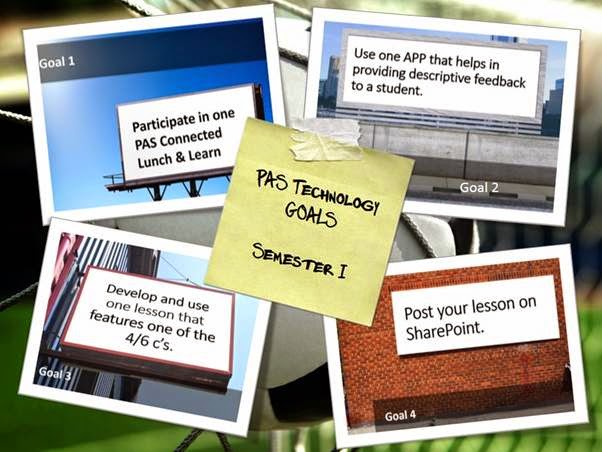
Setting of goals for staff:
We have set four goals for first semester for staff to use as a target to shoot for.
Shift from focus on Technology to a focus on Teaching and Learning
Good teaching will always be good teaching and this needs to be our focus. In good teaching the needs of the learner needs to be our focus. We are moving our focus to skills first technology second. We need to provide students with meaningful learning opportunities that engages them in a process of content creation rather than content consumption.
Regular and ongoing communication and planning with the Teaching and Learning Committee
This used to be out Technology committee. Technology cannot be an add on, an extra. We need to focus on the structure of our learning opportunities for students and to do this our team will meet on an ongoing basis to determine direction and the effectiveness of our efforts.
It is through these efforts that we hope to avoid the flash in the pan phenomenon of professional learning and that our efforts with Teaching and Learning have deep impact on our school.
What are your thoughts and suggestions on ensure deep impact from professional learning?
This is a cross post that also appears on http://peel21st184.wordpress.com/. The goal of this project is share our stories and promote 21st Century learning. The goal is to have as many of our voices heard from students, teachers, administrators, superintendents, Educational Resource Facilitators, Early Childhood Educators, parents and any key players in our schools.
What did I learn today?
Every day that I get to work
with students, I learn how incredibly resilient our students can be.
Today, I was reminded of
this as I was with my family at Canada’s Wonderland. As my car was heading out on the Leviathan, I
thought I had heard my name called. I
asked the person I was with if he had heard my name being called and he said
that was just my nerves talking.
After my 3 minute ride we
pulled back into the station and once again the announcer was talking and at
the end of his announcement he said, “ and Mr. Pearson, I hope you enjoyed your
ride!”This time I know it wasn’t my
nerves talking, I looked into the booth and there was a former student, smiling
behind the glass at me.We had a brief moment
to catch up.He is now training to be in
the military working on jet engines.A
goal he had stated to me 4 years previous.A remarkable accomplishment for him, as I look back and consider what
this student did to get to where he is today.
My memory might be fading
at this point, but here is the long and short what he had to overcome: multiple
school changes, over an hour and a half bus ride to come to school, multiple
suspensions, multiple issues with teachers, multiple issues with me and
multiple issues within himself.
In my three years with
this student, we took the time to get to know each other when times were good
and we built that relationship where he still felt safe when times were not so
good; when he need to be cooled down, or even sent home. He knew he could come back and that he would
be held accountable for what had happened.
We took the time to work through his mistakes together, it is what he
needed, and really what all students need.
Together we created a relationship where he felt comfortable to learn
from his missteps, to reflect on what had happened. He learned to never give up, he learned that
failing was okay. Most importantly, he learned
that he had someone that he could lean on and trust. I also have to say that he taught me so much
as we went through his time in high school.
This student came to believe
in himself, that he could grow both academically and personally and this is what
helped him overcome the obstacles life presented him. This strength or mindset is what will see him
through to his goals. He believed that he was not fixed in the die that life
had cast for him.
Today, I was reminded
that the amazing students we work with can:
Inspire.
Greatness.
Together.
It’s funny that I
remembered all of this after a roller-coaster ride of up’s and down’s, much like
life can present us with.