![]() |
| http://1.media.collegehumor.cvcdn.com/22/28/821c5e995774095937b9811ae6d995cf-man-drinking-waterfall.jpg |
Sunday, 6 March 2016
Taking a drink from the waterfall
Monday, 29 February 2016
A Must Read - The Innovator's Mindset
Here is the short of it:
- #InnovatorsMindset is told in a narrative the draws readers into the learning story.
- This book is great for Central Admin, Principals, Teachers and Parents - everyone can be a learner!
- This will open the reader up to new perspectives, new ways of thinking and most importantly, new ways of learning.
- Not only a passionate narrative, but George lays out a solid foundation and plan to improve school culture and the learning environments in our buildings.
- The ideas in this book are transformational!
And the long of it:
I have read many a resource on supporting learners, assessment, leadership, 21C teaching and learning and innovation. Many of these books, while having some valid points, lack the personal touch and narrative. These two points are extremely important when it comes motivating staff to take action and bring about a change in learning for students. The Innovator's Mindset by George Couros (@gcouros), has BOTH of these and easily engaged our staff.
The personal narrative the George winds throughout the book entices readers along in their learning journey throughout all of the chapters. This narrative causes readers to reflect on their practices and asks them if they are bringing out the best in our students. Further to this, the narrative also encourages staff to create a safe culture and to focus on building relationships where all people feel safe as they challenge their current practices and educational philosophies.
Our staff have been reading this book as we re-examine our school's vision and we craft our new direction and it meshes perfectly with what we are doing. The discussion questions at the end of each chapter assist staff to deepen their understanding and broaden the possibilities of innovative learning opportunities. The resource links that George provides are current, relevant and engaging and are highly suitable for professional learning opportunities. They really help to illustrate the points that George makes and they resonate with staff.
Initially we purchased copies of this book for just our school leadership team. Our staff were so engaged and passionate about the book, we purchased copies for everyone in our school. We are also undertaking the revision of teaching and learning for our entire school board; and we purchased copies of The Innovators Mindset for everyone on the committee.
George's book is a must have for any organization looking to help people out of their comfort zone in order to build innovative learning environments for students.
Tuesday, 14 April 2015
We Have to Stop Pretending - My 5 Things
- Covering content is the same as creating content.
- Talking about critical thinking instead of doing critical thinking.
- Sitting in rows, having students grouped by age is the best way to learn.
- Learning is best done when broken up into subjects and units.
- Textbooks are the best material to drive our lessons.
Please visit +Scott McLeod blog, http://dangerouslyirrelevant.org/2015/04/we-have-to-stop-pretending.html to see his original post.
I tagged, @tina_zita @pmillerscdsb @Gregbagby @jameseliasnunes @plugusin @leslie_edu
Remember to TAG 5 others.
Tuesday, 17 February 2015
You don't have to be first to really lead
We should always do what is best for our students. From my days developing DI portfolios for grade 10 History, to hand coding webpages so that my class and their parents could have access to materials, to embedding a critical thinking methodology into department courses, they were always done because I believed it to be best for kids. It was this conviction that built support for these ideas from department members and other staff. While I may have had the initial nugget of an idea it was only ever with the help, support and the willingness to innovate from my colleagues that allowed these ideas to come to fruition. Great things can happen when you start working from what is best for students.
No teacher wakes up and says, "today I choose to do exactly what I have done before even if it isn't good for kids." Most teachers and administrators, do what they believe to be best for kids. Even when they can't do what was best for kids, it isn't because of a lack of want. It is usually because they can't get from their start line to the finish, or they do not even know where the finish is - or if the finish even exists (in education there really is no finish). No teacher ever wants to be left behind. It is our job to listen to their concerns and wisdom from years of teaching and seek common ground. If a teacher isn't doing what's best for kids in our eyes, they are not certainly doing what's worst for kids in their eyes. We need to see things from their perspective; find common ground and start building our common ground to start working towards what is best for kids.
It is better to support teachers than pull them along.
Listen, model, learn together - My day cross country skiing.
![]() |
| https://www.parentmap.com/c/528547a9/images/enews/content/joanna_nesbit_ty_and_dad_skiing_manning_2008.jpg |
Wednesday, 21 January 2015
Powerful Ideas - Powerful Visuals
I made these images with @canva. A great tech tool canva.com.
You can find these images on twitter,
Tuesday, 20 January 2015
Connected Culture, Collaborative Culture: Comes From the Top!
It offers some great ideas for leaders to engage their community, but not just on Twitter, really their suggestions work on creating a positive culture that will be able to accomplish anything.
| http://41.media.tumblr.com/tumblr_m6lv6gWSct1qz8089o1_1280.png |
Next, they suggest displaying your Twitter handle. This is great for Twittet but don't forget to show how else you connect and to also display how you want others to teach and learn.
The third example of real time encouragement is crucial, again crucial not just on Twitter. It's easy to retweet and favourite, but it takes a real effort and go the extra mile and talk face-to-face with others and let them know how much you appreciate what they do. I need to work on the face2face component as well.
Their fourth point really comes down to voice. Let people know that their voice is heard. This goes for staff and students. The twitterfall in the staff room is a great plan. I will use our hallway LFD TV for this.
We need to trust our staff that their backchannel Chet's on Twitter and at the water-cooler will be purposeful and have meaning. The more open we are the more conversation and the greater the ideas will become.
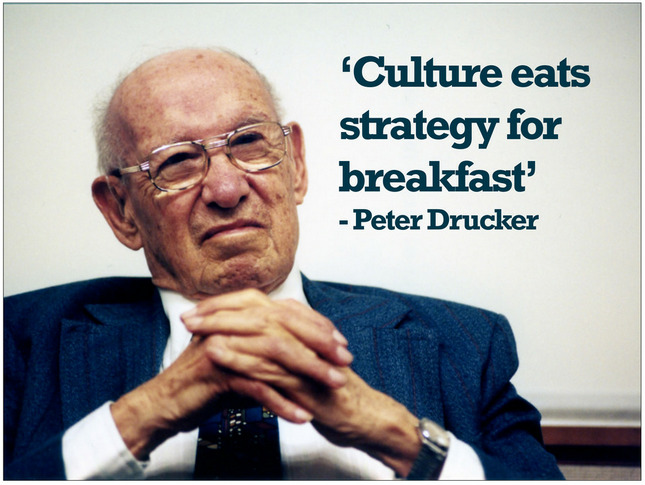
The Final point on creating a team will naturally occur if we pay attention to all of their other points. If we create a safe, collaborative environment where we learn together great things will happen. And as Drucker says, "culture will eat strategy for breakfast."
Monday, 1 December 2014
A tinnie, tiny story about the power of Twitter
Thursday, 27 November 2014
What are Your Big Three?
I then returned to the tag line of my blog, these are and will be my big three:
Instruction LEADS, Relationships ENGAGE, Technology EMPOWERS!
Instruction leads the learning for staff and students in a school. Learning is the cornerstone, the foundation for everything we do. If we are not all learning effectively, what is the point? We need to ensure that we keep this focus when the maelstrom of issues get thrown at us, if we do this we will always have a focus and clarity to see us through to our goal.
The connections we make, the relationships we development with students and staff are the next most important thing we can do. It is the WHO we are, not the what we do that will bring our reluctant learners (students and staff) into our building, into our learning. These connections, both virtual and realtime, are truly what will help us maintain focus and direction in times of crisis or disruption. When we are able to show students and staff the relationships/connections between ideas and knowledge real learning happens. Relationships/connections matter.
Once we have our learning, our instruction, our relationships and connections created we can truly empower learning for all. This empowerment can come from our use of technology as we give everyone in our school a voice. A voice they might not have had if it were not for our instruction, or relationships and if we did not empower them through the use of technology. Student voice will come from their ability to create tremendous products of their learning.
While I have a continuum for my big three, could I put them in a hierarchy? Let me know what you think.
Tuesday, 18 November 2014
What 21st Century Education Means to Me
Education needs to be about students and teachers being:

That's it, that's all...I wrote this whole post without saying 21st Century or technology! Oh darn I just did!
Other blogs involved in this blog hop:
Susan Campo – http://susancampo.ca
Josh Crozier - http://joshcrozieredu.wordpress.com/
Jim Cash – http://makelearn.org
Shivonne Lewis-Young – http://slewisyoung.wordpress.com
Greg, Pearson – http://leaderinadigitalworld.blogspot.ca
Phil Young – http://sphillipyoung.wordpress.com
James Nunes – http://joyousteaching.blogspot.ca
Donald, Campbell – http://ateachingyear.wordpress.com
Ken Dewar – https://mysite.peelschools.org/personal/P0031112/Blog/default.aspx
Graham Whisen – http://ideaconnect.edublogs.org/
Heather Lye – http://teachinginspiraXons.blogspot.ca/
Lynn Filliter – http://assessmentgeek.edublogs.org
Debbie Axiak – http://debbieaxiak.blogspot.ca
Alicia Quennell – http://aliciaquennell.blogspot.ca/
Jonathan So – http://www.Mrsoclassroom.blogspot.ca
Jim Blackwood – http://jimmyblackwood.wordpress.com
Jason Richea – http://beyondangrybirds.blogspot.ca/
Tina Zita – http://misszita.wordpress.com
Heather Lye @MsHLye
Engy Boutros @mrsboutros
George Couros @gcouros
Sunday, 9 November 2014
Once again technology is about connections
At this conference I was able to find several teachers I had taught with over 10 years ago by finding them on the #BIT14 hashtag. I would have never looked them up had it not been for a conference on technology. I found them using technology.
I renewed a friendship with a colleague from another board that I worked with on OHASSTA. I think it had been about 4 years since we last talked. Lots of great face-to-face conversations occurred and great ideas shared once technology let us find each other again.
Even though I work in the same school board as many of the attendees at the conference and have had twitter convos with them, it was our common desire to effectively use technology to reshape education that brought us together. Twitter helped us find each other when we were in the same workshops together.
Finally, people I had followed and have been followed by on twitter were able to find me, and I them. I was able to meet people from across Canada, people I would not have known even existed if it were not for technology.
Technology brings people together, so that we can share ideas and learn from each other.
More than just a FLASH in the pan - professional learning and DEEP impact on teaching and learning
Our school team just returned from BIT14. What a great conference with loads of exposure to new ideas of how to effectively integrate technology into the classroom. Our staff was pumped and their excitement only continued to grow as the the conference continued. Staff came back talking about what they learned, were tweeting out about their learning and even after the conference emailed and called me with their plans for implementation once we got back to our school.
As I sat at home on Friday evening, I started to reflect on our plan to stretch this excitement out to ensure that the knowledge gained at the BIT14 conference has a meaningfully impact at our school. Too often staff excitement that builds while they are immersed in professional learning at a conference gets quickly eroded away as they return to school and the demands of our job (report cards, lesson plans, student issues, etc) way heavy on our time and we forget about what we have learned. I get it, I was there. So how do we get this learning and excitement to be more than a flash in the pan?
As we were at the conference, we would sit and debrief our learning over breakfast, at lunch and during dinner. I started the conversation early over how do we bring this back to school, how to ensure our participation at the conference, our excitement and our new leanings has a long-lasting and meaningful impact on our school. I brought up the idea of 'first-followers" with our staff. We discussed their role to bring the other teachers along at our school. I talked about Derek Shivers' video, Leadership Dancing Guy, as a good example:
While our first followers are the ones that are already won over, it is the 2nd, 3rd and fourth followers who are even more important. How do we get these staff involved? For me this question and the answer, is important in stopping the flash in a pan syndrome. This is our task, myself being the leadership dancing guy and those staff who attended, BIT14, the first followers need to accomplish.
Our Ideas (they are not in any order of significance):
- Admin Support
Heck our principal approved staff attendance at the conference and is always willing to find creative ways to support staff in their learning. Our admin team has a highly consultative process and reach out to staff in order to determine their professional learning needs. Our Principal even wants to try an edcamp style staff meeting. The support is there, the modelling is there, the direction is there.
- Professional learning opportunities for all staff
We are hosting a series of connected lunch and learns using Microsoft Lync 2013. This provides teachers access from their classroom, during their preparation periods or after school. We took staff input on what they wanted to learn and will provide a series of workshops that are leveled (from noob to expert) in order to meet staff where they are. We are creating a great collaborative culture where staff can learn from each other. We have created groups of staff who are exploring Learning Management Systems to ensure they can support all of our staff. We work with our Instructional Technologies Resource Teachers to ensure they are available to directly support staff in their learning and teaching. We have Professional Learning days, with dedicated teaching with technology time. This is also the same for an early release day as well.
- Build a SAFE environment for staff
We are encouraging some risk/chance taking for staff. We are encouraging staff to step out of their comfort zone. We are encouraging them to be creative and look at things from new perspectives. Staff are supported in these adventures by admin and we have made it clear that while we will have the best intentions things will not always turn out the way we expect. THAT IS OKAY!
- Setting of goals for staff:
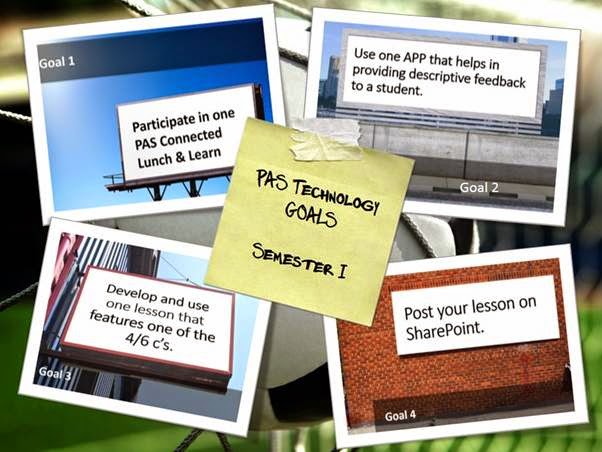
We have set four goals for first semester for staff to use as a target to shoot for.
- Shift from focus on Technology to a focus on Teaching and Learning
Good teaching will always be good teaching and this needs to be our focus. In good teaching the needs of the learner needs to be our focus. We are moving our focus to skills first technology second. We need to provide students with meaningful learning opportunities that engages them in a process of content creation rather than content consumption.
- Regular and ongoing communication and planning with the Teaching and Learning Committee
This used to be out Technology committee. Technology cannot be an add on, an extra. We need to focus on the structure of our learning opportunities for students and to do this our team will meet on an ongoing basis to determine direction and the effectiveness of our efforts.
It is through these efforts that we hope to avoid the flash in the pan phenomenon of professional learning and that our efforts with Teaching and Learning have deep impact on our school.
What are your thoughts and suggestions on ensure deep impact from professional learning?
Monday, 6 October 2014
What did I learn today?
![]() |
https://www.canadaswonderland.com/images/rides/Leviathan-image-3.jpg
|
Sunday, 28 September 2014
My Diigo Links of the Week (weekly)
-
Why You Need to Fail - by Derek Sivers - YouTube
The importance of failure - for effective learning, growth mindset, and quality through experimentation.
Tuesday, 16 September 2014
Can't find something...you should've put it in your POCKET!
So, what is Pocket?
Pocket is a cross platform, cross device, visual bookmarking service that will help turn you into an Web 2.0 ninja. Pocket can be used on almost any device, using almost any operating system that will allow you to easily save, but more importantly retrieve articles when you have more time, or when you actually need them.
How do I put things into my Pocket?
In most cases things can be put into your pocket with one click, touch and swipe using extensions in Chrome or by using bookmarklets on iOS. Once these are setup, it is one touch on the tool bar, or one touch on the share icon and you can automatically send things to your pocket for when you have time to read them later.
What does Pocket do with my finds?
Pocket will parse the articles and remove unwanted adds and distractions that will help you read items at a quicker pace. Pocket also archives the articles so you can have offline access to blog posts or articles and this even allows access to the content when the host site is down, the article has been move, or even worse, the article has been deleted. Pocket lets you view your items in either the streamed lined list view or the graphically stunning thumbnail view. As a visual person, I enjoy using thumbnail view the most, but when I am in a hurry I revert to list view. Pocket even has different colour themes for you viewing pleasure. I like to use the dark theme so I can easily read articles at night without the bright glaring screen of my tablet. Further to this, videos can be played directly from within your Pocket. Talk about time saving.
What do I do with articles once they are in my Pocket?
You read them! Besides this obvious remark, there are some great functions within Pocket that allow you to sort, filter and organize items to make finding them easier when you need them. The most powerful tool in Pocket is the tagging feature, this allows for quick searching later. You can add tags as you find and read articles. If you have made a mistake, you can delete tags as well. Actually if you made a mistake in saving an article, you can simply delete it from your pocket as well. You can also search your pocket by keyword, article title and resource title. Once you have reviewed an item, you can check it off as read and it will send it to your archive for access later. This saves some room in your pocket for even more great discoveries. You can also favourite articles you have read, for easy access to your top finds.
What else can I do with Pocket?
Pocket is integrated with over 500 different apps, which makes it uber easy to send items to your pocket and share items from your pocket. Pocket integrates with Twitter, Zite, Feedly, and Evernote to name a few. In most cases you can once again use pocket to share with one click, touch or swipe to many of your favourite networks like Facebook or share to public booking sites like Diigo (my fav) or Delicious. Adding the Web 2.0 service IFTTT automates many things and makes both the finding and sharing of items even easier from Pocket. You can even use IFTTT to automatically send new posts or articles from your favourite bloggers or news sites, so you never miss anything. I have also started to further archive my Pocket by integrating with Evernote. I can send items, along with their tags for always and ever access in Evernote.
- Code.org by Erica Armstrong
- Puppet Pals by Debbie Axiak
- Scratch Jr. by James Cash
- Educreations by Matthew Oldridge
- Pocket by Greg Pearson
- IFTTT by Jason Richea
- NFB StopMo by Graham Whisen
- Notability by Phil Young
Sunday, 7 September 2014
My Diigo Links of the Week (weekly)
-
How to Be Relevant in Our Students’ Lives | ASCD Inservice
As teachers, we all too often hear students asking, “When are we ever going to use this?” Unfortunately, there is sometimes little immediate connection between content and the real world, leading to students opting out and not paying attention.
-
Professor Says College Students Should Be Taught How To Tweet - Business Insider
While this idea might not be entirely novel, it's coming from an interesting person. Lunsford is highly respected as an academic, and is also incredibly hip. She's blogged about the modern linguistic uses of the word "like." She has also taught at...
-
Seriously. How Much Sleep Do You Really Need? | Edudemic
As most teachers are heading back to the classroom for the start of another school year, many are bemoaning the loss of something they’ve grown accustomed to over the summer: more sleep.
-
How Open Badges Could Really Work In Education | Edudemic
Higher education institutions are abuzz with the concept of Open Badges. Defined as a symbol or indicator of an accomplishment, skill, quality or interest, Open Badges are not only a hot topic as of late, but are also debated by some critics as th...
-
I'm a Teaching Veteran -- Not a Dinosaur | Nancy Barile
A flipped learning guru from the west coast recently visited my school for an afternoon professional development session. He started his presentation by remarking about how impressed he was during his walk around our school building because "the f...
-
How Emotional Connections Can Trigger Creativity and Learning | MindShift
Scientists are always uncovering new ways into how people learn best, and some of the most recent neuroscience research has shown connections between basic survival functions, social and emotional reactions to the world, and creative impulses.
-
What factors go into determining how many Twitter followers you gain (and lose) each day? I was driven in part by Rand Fishkin's recent "mad scientist" experimentation that he touched on at MozCon. There, he noted that his tweets with images resul...
-
Ten Medieval Inventions that Changed the World
Ten Inventions from the Middle Ages that have had lasting importance, even to the present-day. Learn more: Time and Clocks in the Middle Ages The Printing Press: As An Agent of Social Change The civil uses of gunpowder: demolishing, quarrying, ...
-
The Top-10 Characteristics of Lousy Leaders - Michael Hyatt
If you look at the major news stories in business, politics, diplomacy, whatever, it’s pretty hard to miss that most of the crises we face are crises of leadership. I once worked for a man who couldn’t pull the trigger on a project, ever.
tags: leadership
-
The 3 C’s of Educational Leadership | Evolving Educators
The changing face of education means there is a change in educational leadership. To keep up with these changes, educational leaders need to engage in the 3 C’s of Educational Leadership: Connect, Contribute, Collaborate.
tags: leadership
-
Leaders are Learners | LeadToday
Leadership and learning are indispensable to each other. – John F. Kennedy A leadership position is not a destination. No one should “arrive” at a leadership position and just sit tight. A leadership position does not make you a leader, it merely ...
tags: leadership
-
How Does the Brain Learn Best? Smart Studying Strategies | MindShift
In his new book, “How We Learn: The Surprising Truth about When, Where, and Why It Happens,” author Benedict Carey informs us that “most of our instincts about learning are misplaced, incomplete, or flat wrong” and “rooted more in superstition tha...
tags: brain
-
27 Ways To Respond When Students Don't Pay Attention
Our initial reaction when seeing the following infographic from Mia MacMeekin was to think about instructional design rather than classroom management.
-
Beyond Knowing Facts, How Do We Get to a Deeper Level of Learning? | MindShift
As educators across the country continue to examine the best ways of teaching and learning, a new lexicon is beginning to emerge that describes one particular approach — deeper learning.
-
From Distraction to Learning Tool: Mobile Devices in the Classroom -- Campus Technology
Once banned in the classroom, mobile devices are becoming more accepted as a teaching and learning tool.
-
There is no perfect lesson, unit, or school any more than their can be a perfect song, flavor, or shade of blue. Every student is different.
-
The Stages Of Education Technology
What’s Wrong With Education Technology? Mobile applications–or apps–have served an important role in the evolution of what’s possible in a classroom. Libraries and textbooks and teachers have been the traditional portals to information in education.
-
Blogging About The Web 2.0 Connected Classroom: Making Curation Easier With @IFTTT
There is simply no end to the flow of information available on the Internet. When it comes to trying to organize it and do something with it you may run into some challenges. I know I regularly am looking for ways to make that process better. Than...
-
We need to start talking about digital overload for our children - The Globe and Mail
Out at a restaurant the other night, it happened again. I sat with two young parents who tugged an iPad out of their diaper bag and placed it before their fussing toddler. Angry Birds = Happy Child. Pouring some more wine, I silently disapproved, ...
Sunday, 31 August 2014
My Diigo Links of the Week (weekly)
-
OECD educationtoday: Are teachers really resistant to change?
Teachers are often accused of conservatism and resistance to change. Many education policy makers can list numerous examples of well-intentioned reforms that were opposed by the teaching profession and their union representatives in the past.
tags: change leadership
-
What Are the Most Powerful Uses of Tech for Learning? | MindShift
When we talk about the digital divide in education, the discussions revolve mainly around two factors: lack of access to the internet and lack of knowing how to use that access in powerful ways that can fuel learning beyond consuming content.
-
Should Kids Get A Trophy For Showing Up? : NPR Ed : NPR
Talk about a spirited debate ... I remember collecting a shelf full of participation trophies from years of playing YMCA soccer. Did they make me who I am ... or spoil me rotten?
-
Teens top the tech-savvy chart while adults lag behind | Digital Trends
If you’re a parent to a teenager this may already be patently obvious, but a new survey has revealed that 14-15 year-olds are the most tech-savvy age group of our generation. The research also found that 6 year-olds had a better understanding of c...
-
Growth mindset – the holy grail of education? | Gorilla Learning Company
I’m going to jump straight in – I think the theory of fixed vs growth mindset is genius. I use the word ‘genius’ very carefully ever since I exclaimed to a supermarket checkout assistant who packed my bags really well ‘ Wow! Genius packing’.
tags: mindset
-
37 Insanely Smart School Teacher Hacks
Because in order to be organized this year, you’ll need a foolproof labeling system. Follow the directions here. They’ve got tons of stylish templates to choose from that you can easily print out with a color printer and laminate as inexpensive wa...
-
'Kids Are Different: There Are Lots of Different Ways to Educate Them' - The Atlantic
There are a dizzying number of theories out there about American education. Smaller classrooms are the solution one day, the next, iPads. Glenn Harlan Reynolds of Instapundit takes on these ideas and makes his own predictions in his new book, The ...
-
How to Get the Most Out of Student-Owned Devices in Any Classroom | MindShift
Allowing students to bring their own devices to class can be a cost-effective way to quickly get access to the internet and to the many useful tools those devices carry. But students don’t always get the chance to use their devices, especially in ...
-
What Students Remember Most About Teachers | Pursuit of a Joyful Life
I saw you as you rushed past me in the lunch room. Urgent. In a hurry to catch a bite before the final bell would ring calling all the students back inside. I noticed that your eyes showed tension. There were faint creases in your forehead. And I ...
tags: relationship teachers
-
Tweeting For Schools | The Principal of Change
Awhile ago, I wrote a post entitled, “What Should A Networked Educational Leader Tweet About?“, which was meant to be a guide to administrators new to Twitter on tweeting and sharing information using this social media tool.
tags: twitter
-
Teachers as Technology Trailblazers: Ready, Fire, Aim - An Important Note About Leadership
"Ready, fire, aim" is the more fruitful sequence if we want to take a linear snapshot of an organization undergoing major reform.
tags: leadership
-
20 useful ways to use TodaysMeet in schools | Ditch That Textbook - Linkis.com
Well done! Now you can keep tweeting the way you usually do. All the boring job will be done for you by our service. This promo is not the same as you indicated in your settings. By deleting current promo you will leave the block blank. Are you sure?
tags: technology todaysmeet
-
Why Tech Still Hasn't Solved Education's Problems - Atlantic Mobile
Remember MOOCs? Two years ago, massive open online courses seemed to be everywhere. The wave of Internet-enabled disruption that had swept through the post office and the book store had now arrived at the classroom, threatening the existence of Am...
tags: integration tech
-
5 Strategies for Building a Powerful BYOD Classroom | Brilliant or Insane
Moving to a Bring Your Own Device school or classroom is a major transition. I’ve heard many horror stories of monumental failures from first-year BYOD teachers, and most could have been avoided with some simple planning. 1.
tags: byod
-
5 higher-ed skills to teach K-12 students now | eSchool News | eSchool News
While the Common Core aims to teach students critical skills that can translate to college, career, and life (critical thinking, collaboration, and writing), a different set of skills can help prepare students to not just survive post-secondary ed...
tags: 21st skills technology
-
Carol Dweck's Attitude - The Chronicle of Higher Education
Carol S. Dweck says that her graduate students here at Stanford University are hard-working, creative, and resilient in the face of failure. But she wouldn't call them smart.
tags: mindset
-
The Conversation We Need To Have With Leadership : Teacher Reboot Camp
tags: leadership
-
Do you have a new school for next year? Or have you just been assigned to your first principalship? We asked the principals of the MetLife Foundation/NASSP 2013 Breakthrough Schools to respond to one or more of the three prompts below, suggesting ...
tags: leadership
Monday, 25 August 2014
My Goals for the 2014-2015 School Year
- Continue to build relationships that will allow us all to achieve our goals.
- Help staff and students see that change does have its benefits.
- Successful integration of 21st Century skills for the entire school.
- Help our teachers and students adopt a Growth Mindset.
- Help staff adopt web 2.0 tools and a better understanding of new technology to their teaching and professional work.
- Help students and staff realize their awesomeness!
Friday, 15 August 2014
Getting Comfortable with Change, I mean TRANSITIONS
As I look back over the last school year and a half, I have gone through:
- 3 principals
- 3 Superintendents
- 3 Schools
- 6 vice principals.
- Sharepoint rollover
- Office365 Implementation
In fact in the last year our staff moved our entire site from one location to another. These are just small examples of the amount of physical changes we go through as digital leaders.
Many say I should have fallen apart with all of the change, besides the fact that I had a great staff keeping it together and I more than loving and supportive wife at home, it was my use of technology schools as well that helped me stay on track and not loose focus. The use off technology remained as everything around me was changing. The apps that I used to help me lead through the change were indispensable in my success. Here is a brief list of them:
Evernote - notes from meetings, ideas, thoughts (@evernote)
Pocket - collected all the information and ideas I would need to be successful (@pocket)
Wunderlist - My second brain and essential task manager/to-do list (@wunderlist)
Twitter - connecting with other educators to seek advice through my PLN (@twitter)
Hootsuite - to manage all of the information as it was coming at me (@hootsuite)
The above apps were essential in managing the transitions that I have gone through, the many changes I was able to lead through. Our students are also going through change. Rapid change, but they have not be taught how to manage it. They have not had the opportunity to have change management modelled for them. We can show them how to manage the change with web tools.
Change is good. Our students do not always realize that. Think of when are students have the hardest time with things, the days leading up to holidays standout for me. Students have a hard time managing through change and we need to model this change for them.
The first thing that I like to do is switch the term from change to TRANSITION. A change is more like doing a u-turn on a highway or a complete stop. A transition is more like a lane change, a slight shift in direction. By modeling these transitions for students, and in fact staff as well, we are showing true leadership. Whether it is some of the physical school changes I mentioned above or a shift in pedagogical direction we can help students and staff though them by taking the first steps. We can show them that the more transitions we make the better we are at handling the transitions of life, such as moving houses, changing schools, or even changing friendships.
We also need to highlight how, over time, when you keep doing the same thing we wear a path into the ground where we have been. These paths in the grass may become deeper the more we walk over them and eventually become ruts. As we know people can get stuck in rut and have a harder time getting out. We need as leaders to model how we can stay out of ruts and stay in the groove. This groove is more of how we manage our daily lives a process rather than a track. We can show how to go with the flow and take control of our situations and better handle our transitions. The last thing we want our students and schools to become is stuck, embedded in the mud.
Wednesday, 6 August 2014
Nobody Said It Was Easy...
Nobody said it was easy
It's such a shame for us to part
Nobody said it was easy
No one ever said it would be this hard
Oh, take me back to the start.
This chorus came to mind after reading the blog post entitled, "The Rise of the Helicopter Teacher" by Steven Conn and posted on the Chronicle of Higher Education. Thanks for the great writing that caused me to reflect on my practice and the purpose for what I do. The following are my thoughts on point from Conn's post, so perhaps read it first.
| http://blake-douglass.com/fear-is-hard-work/ |
So you don't use rubrics, not at post secondary education? Now, not everything requires a rubric, but major assignments/tasks should at least be put forth with, at the very, very, very least a set of expectations so that students know how they will be evaluated. Scaffolding anything we do provides the structure for success and better student product. Even when we evaluate teachers it is an open conversation where we inform the teachers of the domains we are looking at. I even allow teachers to select several they would like me to pay particular attention to. Its not just about rubrics its about information and everyone knowing how they will be evaluated. I expect this for myself and I will ensure I give it to teachers and students.
As far as failing, there is nothing wrong with students struggling and failing, as long as they learn why they failed. If you do not provide them meaningful feedback then how will they improve. If they do not know how they are evaluated how will they learn? We need to ensure we nurture a growth mindset in our students, so they can see where they fell short when measured against criteria and how to improve for the future.
Yes technology has opened the lines of communication. However, we need to take control and set limits of when you are available on email, twitter, FB or a chat room in a LMS. We still have the control to set reasonable limits for students. Students need structure, they crave it. If you set ongoing communication framework for students, and have regularly scheduled hours for this communication to occur, then we can avoid the last minute rush of panicked emails, texts and DM's!
Face-to-face meetings with my prof? That was horrific time for me, I would have prefered to build my relationship first and then move towards face-to-face interactions. This is what technology allows us to do. It is an evolution not a de-evolution!
When I was a student in school I was ahead of most, not because of my intelligence, not because of my time management skills, not because of my prioritizing, but because I learned how to play the game. I was engaged only when I needed to be. I drove teachers nuts. Loads of potential but no motivation to play the game 24/7. I did what I had to do in order to get by, I wasn't engaged. I had figured out a framework for success without it being shown to me. I was luckily, all my classmates were not. By providing students with outlines of how they will be assessed or chunking larger tasks into parts we are providing a framework and structure for students who haven't figured out the game. We are merely leveling the playing field for all, not spoon feeding.
We can do all the above, while still challenging our students with intellectually stimulating tasks. All the while, providing rubrics in order showing them what to do and how to do it. This is our task. This is our job. This is what we signed up to do! Conn is right, we cannot drag them around the dance floor, it takes more than two to do the educational tango. However, engaging students in the learning process through rubrics, descriptive feedback, open communication, critically thoughtful assignments and providing frameworks for success are all steps in that dance. Remember, nobody said it was easy...
Feedback and thoughts please....